CORALS 4 KIDS

Threats
Coral Reefs are starting to disappear...
There are many reasons why coral reefs are struggling in today's world, some of them are natural and others are caused by humans. Below is a list of some of the main issues that are causing a decline in the health of coral reefs.

Photo taken by the United State Geological Service. Black Band Coral Disease.

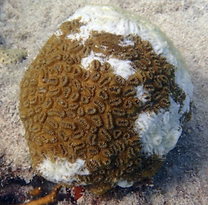
Photo taken by the Coral Disease and Health Consortium. Stony Coral Tissue Loss disease.

Photo taken by Coral Digest. Red Band Disease.
Photo taken by Dr. Ernesto Weil from the Puerto Rico Department of Natural Resources. Yellow Blotch/Band Disease.
Diseases:
-
Black-band disease is caused by bacteria that suffocate the coral polyps, leaving behind the calcium carbonate skeleton. The main symptom that we can see of black band disease is a black line surrounding the dead skeleton left behind by the disease and the healthy coral surrounding it (Black-Band Disease in the Florida Keys | U.S. Geological Survey, n.d.).
-
Red-band disease for instance only affects species like sea fans and leaves behind a red line on the coral skeleton (Red Slime Algae (RSA) or Red Band Disease (RBD), n.d.).
-
Yellow blotch/band disease affects star corals in the Caribbean Sea (Cervino et al., 2008).
-
Stony coral tissue loss is a more recent coral disease that causes patches of coral to slowly recede in patches with no noticeable line between healthy and dead tissue. It was first discovered in 2014, and this disease is currently a problem for 20 species of coral in the Caribbean Sea and is spreading (Stony Coral Tissue Loss Disease (SCTLD) - Coral Disease & Health Consortium, n.d.).

Hurricane Katrina in 2005. Photo by NOAA.

Pillar Coral after hurricane. Photo by NOAA and National Marine sanctuaries.
Storms:
-
Did you Know? Some species of coral actually can reproduce from the fragmented pieces? Corals can have pieces of their skeleton broken off, but some species will continue to reproduce through fragmentation and start a whole new colony (Hurricanes: Friend or Foe to Coral Reefs?, n.d.).
-
Hurricanes/ Typhoons are the same weather system. In Australia, they use the word cyclone whereas the USA refers to this storm system as a hurricane. This extreme weather often has high winds that can move thousands of gallons of water and can expose reefs. It also can cause waves that are so powerful that they can break off pieces of coral from under the water (What Is the Difference between a Hurricane and a Typhoon?, 2023) (Hurricanes: Friend or Foe to Coral Reefs?, n.d.).
-
Did You Know? Damage from a hurricane is determined by the Saffir-Simpson Scale which uses wind speeds to determine how extreme the storm is, with the most damaging winds at 157 mph or higher (Saffir-Simpson Hurricane Wind Scale, n.d.)!
Predators
Corals are an animal that has predators just like other animals. The predators look different from the ones on land, but if the population of predators is out of control, it can destroy the population of healthy coral on a reef. If you are interested in learning more about specific predators of corals, head to the Ecology page and scroll down to the description of the Crown of Thorns Starfish (Crown-of-Thorns Starfish - Oceana, n.d.)!

Crown of Thorns Starfish taken in 2017. Photo by Emma Grund

An empty, plastic rice bag is nestled between corals. Photo by Kathryn Berry/James Cook University.

Different pieces of trash floating in the ocean. Photo by Environmental Investigation Agency.
Pollution
-
Plastic
-
Plastic pollution first of all will impact the organisms that live in and around the reef looking for food. Sea Turtles and fish can and will eat plastic if given the chance since plastic often looks like other food sources the animals are used to (Plastic Pollution Facts and Information, 2019).
-
The plastic also can impact the health of the corals themselves. Plastic will often carry bacteria and other chemicals that can cause disease in corals. The presence of plastic near a coral can attract other cyanobacteria in the water and can increase the chances of the coral developing diseases like black-band disease (Lamb et al., 2018).
-
This is why using reusable products instead of single-use plastic can improve the reef systems and the amount of plastic that ends up in the oceans. Bring your own reusable water bottle, bag, or food container to different places so single-use plastic does not end up in the ocean (Plastic Pollution Facts and Information, 2019)!

Mississippi River colored brown from sedimentation, runoff chemicals, and nutrients from fertilizers. Photo by NOAA.

Dead zone of the Gulf of Mexico that extends out past the mouth of the Mississippi River and into the Gulf. Photo by NOAA.
-
Run-off
-
Run-off is any water that does not absorb into the ground and runs into rivers, streams, and other bodies of water and ends up in our oceans. (Runoff, n.d.).
-
The run-off water can carry lots of potentially dangerous chemicals, bacteria, and nutrients from farms, factories, and other areas that can increase algae growth, causing the oxygen levels to decrease. (Runoff, n.d.).
-
Near the mouth of the Mississippi River below the state of Louisiana, there is a portion of the Gulf of Mexico where there is little animal life called the dead zone, and this is due to the amount of runoff chemicals coming from a variety of sources running into the water (Gulf of Mexico Dead Zone, n.d.). See the photo above to see how large the dead zone is!
-
Did You Know? There are links now to some research that might link the runoff of fertilizers to an increase in disease in Green Sea Turtles called fibropapillomatosis. This disease causes large tumors to grow on the soft parts of the turtle and can eventually kill the turtle because the tumors are too large and restrict movement (Runoff, n.d.; Witherington & Witherington, 2015).

Coral covered in sand and sediment. Photo by Australian Institute for Marine Science.
-
Sedimentation
-
This process happens when dirt or sediment collects on top of coral reefs. This process usually occurs near the mouths of rivers or where other bodies of water can pick up sediment (WAPA - What Is Sedimentation?, n.d.).
-
Corals can be smothered directly by the sediment since they can't move and move the sediment itself (WAPA - What Is Sedimentation?, n.d.).
-
The sediment in the water can impact how much sunlight reaches the coral, which can impact the algae’s ability to photosynthesize. The corals can then starve because of a lack of nutrition (WAPA - What Is Sedimentation?, n.d.).
-
Did you Know? Sedimentation can increase for many reasons like large amounts of rain fall that collect dirt and recently disturbed sediment on farms or from mines can easily come into waterways and increase the sediment in the water (WAPA - What Is Sedimentation?, n.d.).

Photo by NOAA Office of Response and Restoration. Technique and use of skimmers to remove surface oil.

Photo by NOAA. Unidentified species of sea turtle covered in oil.
-
Oil Spills
-
The corals can become covered in oil, which can kill off chunks of coral since they can not get the nutrients they need through the oil. Also, oil can impact corals' ability to reproduce and grow, which can affect their life span and population (How Do Oil Spills Affect Coral Reefs? | Response.Restoration.Noaa.Gov, n.d.).
-
Organisms that live on the reef can become covered in this oil as well, impacting their senses and also eating that oil on their food sources (How Do Oil Spills Affect Coral Reefs? | Response.Restoration.Noaa.Gov, n.d.).
-
During an oil spill, different types of dispersants and equipment used to control the flow of oil can impact the health of the corals as well, such as chemical dispersants (Spill Containment Methods | Response.Restoration.Noaa.Gov, n.d.; How Do Oil Spills Affect Coral Reefs? | Response.Restoration.Noaa.Gov, n.d.).
-
Did you Know? When an oil spill occurs near a reef, national organizations will advocate for other equipment like skimmers to be used to stop the spread of oil to the reef, since the chemicals in the dispersant can also harm the corals (Spill Containment Methods | Response.Restoration.Noaa.Gov, n.d.; How Do Oil Spills Affect Coral Reefs? | Response.Restoration.Noaa.Gov, n.d.).
Florida Keys National Marine Sanctuary. Photo taken by Emma Grund

Ocean Acidifidation
-
Did you Know? The process of ocean acidification has been a recent event spanning back to the beginning of the Industrial Revolution (What Is Ocean Acidification?, n.d.).
-
With the increase in fossil fuels being burned and releasing carbon dioxide into the atmosphere, our oceans have been naturally absorbing that carbon dioxide to use in a variety of ways. However, too much carbon dioxide increases the amount of hydrogen that is in the water, which decreases the amount of calcium carbonate that can be made (What Is Ocean Acidification?, n.d.).
-
Did you know? Calcium carbonate is a specific chemical compound that is necessary for the creation of calcified shells for oysters, clams, sea urchins, and the corals themselves (What Is Ocean Acidification?, n.d.).
-
Corals build their skeletons using the calcium carbonate floating in the water from this process, so the increase in carbon dioxide in the atmosphere means an increase in the ocean. This can be deadly for corals since the skeleton they build protects their fragile bodies from predators and harsh conditions (How Is Climate Change Affecting Coral Reefs?, n.d.).


Tips of different corals showing signs of coral bleaching. Photos by Emma Grund
Coral Bleaching Events
-
These coral bleaching events can occur when water temperatures increase over a certain temperature for a long period (US Department of Commerce, n.d.-b).
-
Increases in temperatures can stress out the corals, and so to reduce that stress, the coral polyps eject their zooxanthellae algae into the water column (US Department of Commerce, n.d.-b).
-
The coral polyps will eject the algae which gives them nutrients and food and without that source of food, corals will eventually die (US Department of Commerce, n.d.-b).
-
Did you Know? The algae that reside within them are what give the coral polyps their color, so when the corals go through a bleaching event, they appear stark white (US Department of Commerce, n.d.-b).
-
Often the remains of a coral bleaching event are large amounts of calcium carbonate skeletons of different types of coral, all white. This can hurt the reef system since the different fish and animals rely on the corals for food and shelter, which can lower the amount of different fish life on the reef over time (US Department of Commerce, n.d.-b).

A fishing vessel collecting its catch. Photo by JASON ALDEN, BLOOMBERG/GETTY IMAGES.
Overfishing
-
Humans use many different forms of equipment to collect as many fish as possible to feed a growing population. However, the constant take means that there are not enough healthy fish that can reproduce and sustain the population (Overfishing, n.d.).
-
Current fishing stocks of certain species are recorded to be at their lowest ever. The impact of irresponsible fishing practices impacts not only the fish that we need for food but also other animals that live on the reef (Overfishing, n.d.).
-
Sea Turtles, Sharks, and even dolphins have fallen prey to ghost nets and other fishing gear like shrimp trawls that will eventually drown the animals ((Overfishing, n.d.; Witherington & Witherington, 2015).
-
Did You Know? The US is one of many countries that have begun to implement fishing practices that help to reduce pressure on the fish populations and improve the survival rate for animals caught as bycatch (Overfishing, n.d.).
Comprehension Check
Lets see how much you learned!
References
-
Cervino, J. M., Thompson, F. L., Gomez-Gil, B., Lorence, E. A., Goreau, T. J., Hayes, R. L., Winiarski-Cervino, K. B., Smith, G. W., Hughen, K., & Bartels, E. (2008). The Vibrio core group induces yellow band disease in Caribbean and Indo-Pacific reef-building corals. Journal of Applied Microbiology, 105(5), 1658–1671. https://doi.org/10.1111/j.1365-2672.2008.03871.x
-
Cloud .Tube (Director). (2017, September 23). The Coral and the Algae. https://www.youtube.com/watch?v=JENUAv0w8Q4
-
Fisheries, N. (2021, February 11). Fibropapillomatosis and Sea Turtles – Frequently Asked Questions | NOAA Fisheries (National). NOAA. https://www.fisheries.noaa.gov/national/marine-life-distress/fibropapillomatosis-and-sea-turtles-frequently-asked-questions
-
Great Barrier Reef Mass Bleaching Event. (n.d.). Retrieved October 31, 2023, from https://earthobservatory.nasa.gov/images/149666/great-barrier-reef-mass-bleaching-event
-
Gulf of Mexico Dead Zone. (n.d.). Retrieved November 7, 2023, from https://www.nature.org/en-us/about-us/where-we-work/priority-landscapes/gulf-of-mexico/stories-in-the-gulf-of-mexico/gulf-of-mexico-dead-zone/
-
How Do Oil Spills Affect Coral Reefs? | response.restoration.noaa.gov. (n.d.). Retrieved October 31, 2023, from https://response.restoration.noaa.gov/about/media/how-do-oil-spills-affect-coral-reefs.html
-
How is climate change affecting coral reefs? (n.d.). Retrieved November 7, 2023, from https://floridakeys.noaa.gov/corals/climatethreat.html
-
Hurricanes: Friend or foe to coral reefs? (n.d.). Retrieved November 4, 2023, from https://floridakeys.noaa.gov/whatsnew/around/2012/hurricanes.html
-
Lamb, J. B., Willis, B. L., Fiorenza, E. A., Couch, C. S., Howard, R., Rader, D. N., True, J. D., Kelly, L. A., Ahmad, A., Jompa, J., & Harvell, C. D. (2018). Plastic waste associated with disease on coral reefs. Science, 359(6374), 460–462. https://doi.org/10.1126/science.aar3320
-
Overfishing. (n.d.). World Wildlife Fund. Retrieved November 11, 2023, from https://www.worldwildlife.org/threats/overfishing
-
Plastic pollution facts and information. (2019, June 7). Environment. https://www.nationalgeographic.com/environment/article/plastic-pollution
-
Red Slime Algae (RSA) or Red Band Disease (RBD). (n.d.). Aquarium Coral Diseases. Retrieved October 31, 2023, from http://aquariumcoraldiseases.weebly.com/red-slime-algae-rsa-or-red-band-disease-rbd.html
-
Runoff. (n.d.). Retrieved November 4, 2023, from https://education.nationalgeographic.org/resource/runoff/
-
Saffir-Simpson Hurricane Wind Scale. (n.d.). Retrieved October 31, 2023, from https://www.nhc.noaa.gov/aboutsshws.php
-
Spill Containment Methods | response.restoration.noaa.gov. (n.d.). Retrieved October 31, 2023, from https://response.restoration.noaa.gov/oil-and-chemical-spills/oil-spills/spill-containment-methods.html
-
Stony Coral Tissue Loss Disease (SCTLD)—Coral Disease & Health Consortium. (n.d.). Retrieved October 31, 2023, from https://cdhc.noaa.gov/coral-disease/characterized-diseases/stony-coral-tissue-loss-disease-sctld/
-
The Gulf of Mexico Dead Zone. (n.d.). Dead Zone. Retrieved November 4, 2023, from https://serc.carleton.edu/microbelife/topics/deadzone/index.html
-
US Department of Commerce, N. O. and A. A. (n.d.). NOAA’s Coral Reef Conservation Program (CRCP)—Coral Facts. Retrieved October 31, 2023, from https://coralreef.noaa.gov/education/coralfacts.html
-
US Department of Commerce, N. O. and A. A. (n.d.-b). What is coral bleaching? Retrieved November 7, 2023, from https://oceanservice.noaa.gov/facts/coral_bleach.html
-
WAPA - What is Sedimentation? (n.d.). Retrieved October 31, 2023, from https://www.nps.gov/parkhistory/online_books/npswapa/Park/Natural/DirtReef/Sediment.htm
-
What is Ocean Acidification? (n.d.). Retrieved October 31, 2023, from https://oceanservice.noaa.gov/facts/acidification.html
-
What is the difference between a hurricane and a typhoon? (n.d.). Retrieved November 4, 2023, from https://oceanservice.noaa.gov/facts/cyclone.html
-
Witherington, B. E., & Witherington, D. (2015). Our sea turtles: A practical guide for the Atlantic and Gulf, from Canada to Mexico. Pineapple Press, Inc.